


MEDIA & ENTERTAINMENT
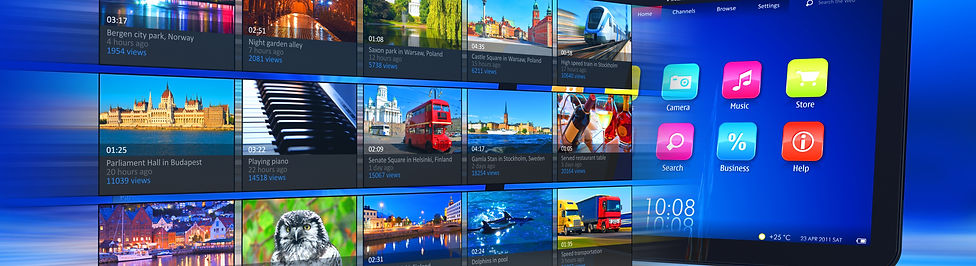
The new behaviors of connected consumers – which include social viewing, distracted viewing and viewing on demand – have greatly impacted M&E providers.
Across all markets, it’s no longer just a minority of young, early adopters who are digitally connected. So are today’s mainstream consumers, a group that cuts across age boundaries and consists of those who characterize themselves as buying electronic devices at about the same time as others.
In the connected consumer landscape, how can M&E providers offer consumers entertainment experiences that are more relevant, and therefore perceived as more valuable? In short, they must move beyond merely distributing digital content.
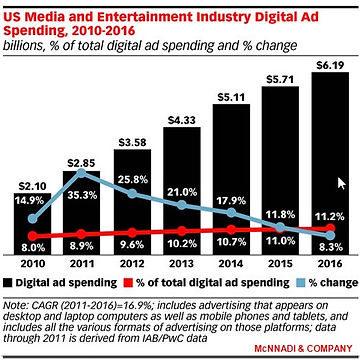
These growth rates look even stronger relative to the rest of the US economy: For the period of 2010-2016, media and entertainment have the two highest compound annual growth rates (CAGR) of all industries tracked—17.8% and 15.8%, respectively. Unsurprisingly, this means that Media & Entertainment’s share of total digital spending is projected to increase every year through 2016.
Today, M&E providers first need to think and act like B2C companies, no matter where they sit in the industry value chain. Second, they should target consumers’ particular digital personalities. Third, they must learn to deliver holistic, relevant content experiences – not just content alone.

When it comes to digital tactics, despite increased interest, the US media and entertainment industries remain heavily rooted in traditional mass market TV, print, out-of-home media, and other offline sponsorship and promotion.

Organizational success depends upon delivering the best media experience possible: a user-driven experience that demands constant innovation and modern infrastructures. Big and dissimilar data must be managed critically in the process. Taming big data is a seemingly impossible task when you consider the ever-expanding digital universe.

One of the biggest challenges facing this industry in realizing its full potential will be the ability to create distribution platforms with enough critical mass that provide users with a rich experience and transact seamlessly (even for small ticket sizes).
There is increasing consensus in the industry is that it is no longer possible to prevent content from being made available online. The recourse for content owners is to invest and create credible platforms where users can consume content effectively and at the same time work towards effective policing of piracy.
The New Media segment continues to power ahead. Digital advertising, social media marketing, gaming etc are all fast growing markets. With the roll out of 4G in 2013 and increasing penetration of wired broadband coupled with widespread use of smartphones and tablets, New Media will continue to be an ever increasing part of the overall M&E industry."
LOOKING AHEAD 2030

Radio - Renewed hope
The radio industry had a muted growth year over year. The overall revenues of listed radio players exhibited a single digit growth rate during the entire year.
The growth in industry's revenues was driven by volume improvements as prices largely stayed stagnant. In certain markets, leaders have been able to raise rates slightly but the overall trend has been to expand revenue through volume enhancement and rate rationalization.
The utilization levels have reached nearly 100 percent during peak season in the top eight metros putting pressure on volume based growth from metros in the near future.
For non-metro players too, utilization continued to be a lever for growth, for example, MY FM's average inventory utilization was at 95 percent in prime time followed by non prime time in the range of 75 to 85 percent.
Radio has been waiting for too long for Phase III and the associated regulatory reforms. After challenging years from 2014 thru 2017, there is now renewed hope that from 2018, the industry will finally see its shackles removed and a regulatory structure enacted that will drive it to the next stage of growth.
Music - Streaming to success
2018 was the year of discovering music - consumers finally showed some indication of broadening consumption beyond Bollywood as other genres showed vibrancy.
Technology enabled personalization in music discovery through various mobile and internet apps while cloud storage assisted in managing the content swiftly.
Social media continued to blur borders and promote music consumption, thereby fostering talent unlike before.
More and more independent artists were able to find an audience and also monetize their content, albeit in a small way. Live music performance also came into its own and provided a platform for audience engagement to both established artists as well as budding talent.
Digital tunes are now being played like never before contributing 57 percent to the billion dollar music industry which grew 18%.
Revenues from digital platforms are expected to gradually gain pace and grow at a rate of 21.7 percent over the next five years.
By 2030, digital revenues will contribute more than 92 percent to the music industry's revenues.
MANAGING THE GROWTH


This growth will be on the back of availability of faster broadband speeds and the uptake of subscription based online music services. Growth in music consumption (both online and mobile) is expected to drive the music industry to staggering revenues by 2030.
Digital and broadcast video are driving growth in the music business. Performance licenses also saw growth. These will continue to drive the industry forward and over the medium term, more than compensate for the loss of revenue from CRBT and radio revenue.
Technology - Changing the game
Six trends that have been identified to change the game include big data compression, cloud, social media, mobility, embedded systems and augmented reality which will have a logical maturity that inevitably brings them together.
The advent of technology has empowered the consumer like never before. The rising presence and reach of the internet, coupled with the prolific growth of smartphones, tablets and related technologies, has provided consumers with unmatched access to information on the go, thereby helping them make informed purchasing decisions.
The adoption of digital media is redefining consumer mindsets, patterns of purchase and decision making. This, in turn, is transforming consumer behavior.
The rapid pace at which digital media is being adopted is also expected to propel growth in the use of associated consumer technology.